
Program · Rafael Rodrigues · O Higienista do EPI
Welder Protection Program
Map, reduce and monitor the exposure of people who weld. Collective controls first, CleanSpace powered respiratory protection as the core, and a financial return measured with data.
Objective
Risk first. Then the product.
The program maps the similar exposure groups (SEGs) in the welding area of a plant or company, classifies the risks of each group and gives the health and safety team, occupational health and purchasing a control plan built on the occupational hygiene steps: anticipate, recognize, evaluate, control and monitor, in line with Brazilian regulations and international references (ACGIH).
For respiratory protection, the program replaces the disposable FFP2/N95 respirator worn under the welding helmet with the CleanSpace powered respirator: more protection, more comfort and usage records. The gain is proven in a pilot and converted into cost figures.
References to NRs (Brazilian regulatory standards), NHOs (Fundacentro technical procedures) and the C.A. (Brazilian certificate of approval for PPE) apply to Brazil. In other countries, apply the equivalent local regulation.
Recognition
Welders face four families of risk at the same time
A single job combines physical, chemical, ergonomic and accident risks. Health effects usually have a medium- to long-term latency, so they appear late, when the liability already exists.
Noise, radiation, heat and electricity
- Noise from grinders, plate handling and the arc
- Non-ionizing radiation: UV-A, UV-B, UV-C, intense visible light and infrared
- Heat from the arc, the flame and the workpiece
- Electric shock
Consequences: noise-induced hearing loss, cataract, radiation conjunctivitis, glare, skin cancer, burns and heat strain.
Metal fumes, gases and vapors
- Metal fumes (iron, manganese and, on stainless steel, chromium and nickel)
- Organic vapors from cleaning solvents
- Gases from anti-spatter products and from the process itself
Consequences: most welding fume particles are smaller than 1 µm, reach the alveoli and overload the macrophages. Pneumoconiosis (siderosis), respiratory failure and lung cancer. IARC has classified welding fumes as carcinogenic to humans (Group 1) since 2017.
Posture, jigs and poorly fitting PPE
- No jigs, or jigs designed without anthropometric study
- Overhead welding and sustained postures
- Inadequate or poorly fitting PPE that is heavy and hot
Consequences: herniated discs and cervical spine injuries, inflammation of arms and shoulders, repetitive strain injuries and thermal discomfort.
Impact, crushing, explosion
- Flying particles and parts hitting the face and head under overhead cranes
- Crushed hands and fingers when moving heavy parts
- Explosion of cleaning solvent in contact with sparks, without proper exhaust
Consequences: serious or fatal injuries to the face and head, amputations, burns and high-current shocks.
Underwater welding and welding at height carry additional risks and are outside this first version. Where they exist, they should be mapped and added to the program.
Method
Five occupational hygiene steps applied to welding
Anticipate
Survey welding processes, materials (carbon steel, stainless, galvanized), consumables, solvents and new line projects before the risk reaches the workstation.
Deliverable: inventory of processes and inputs by area.
Recognize
Visit the workstations and build the similar exposure groups. The same job title does not mean the same risk.
Deliverable: SEG map with the agents of each group.
Evaluate
Measure what needs to be measured: metal fume sampling, noise dosimetry with octave-band analysis, WBGT for heat and ergonomic analysis of workstations.
Deliverable: exposure report compared with the limits of Brazilian standard NR-15 and ACGIH.
Control
Apply the hierarchy of controls: collective measures, then administrative measures and, last, the right PPE for the measured risk.
Deliverable: prioritized action plan and PPE technical specification.
Monitor
Track real PPE use, filter changes, complaints and health indicators. Reassess when processes, materials or layout change.
Deliverable: quarterly report with respirator usage data.
Production-line welder in a booth
Tack welds inside a booth with a protective curtain, no overhead crane traffic, working local exhaust and jigs.
Boilermaker welder in an open area
Operates the overhead crane, welds without jigs and works with ineffective or no ventilation.
Both have the same job title and different risks. That is why the PPE specification comes from the SEG, not from the job title.
Control
PPE comes last in the hierarchy, and it stays with the welder all day
Whenever possible, collective controls come before PPE. The program points out each one and brings in the right specialist.
Respiratory pillar
Why disposable respirators fail under the welding helmet
On paper, the FFP2/N95 is there. At the workstation, it gets hot, damp with sweat, loses its seal with beards and movement, and ends up being taken off. PPE the welder cannot stand wearing does not protect.
The proposed change
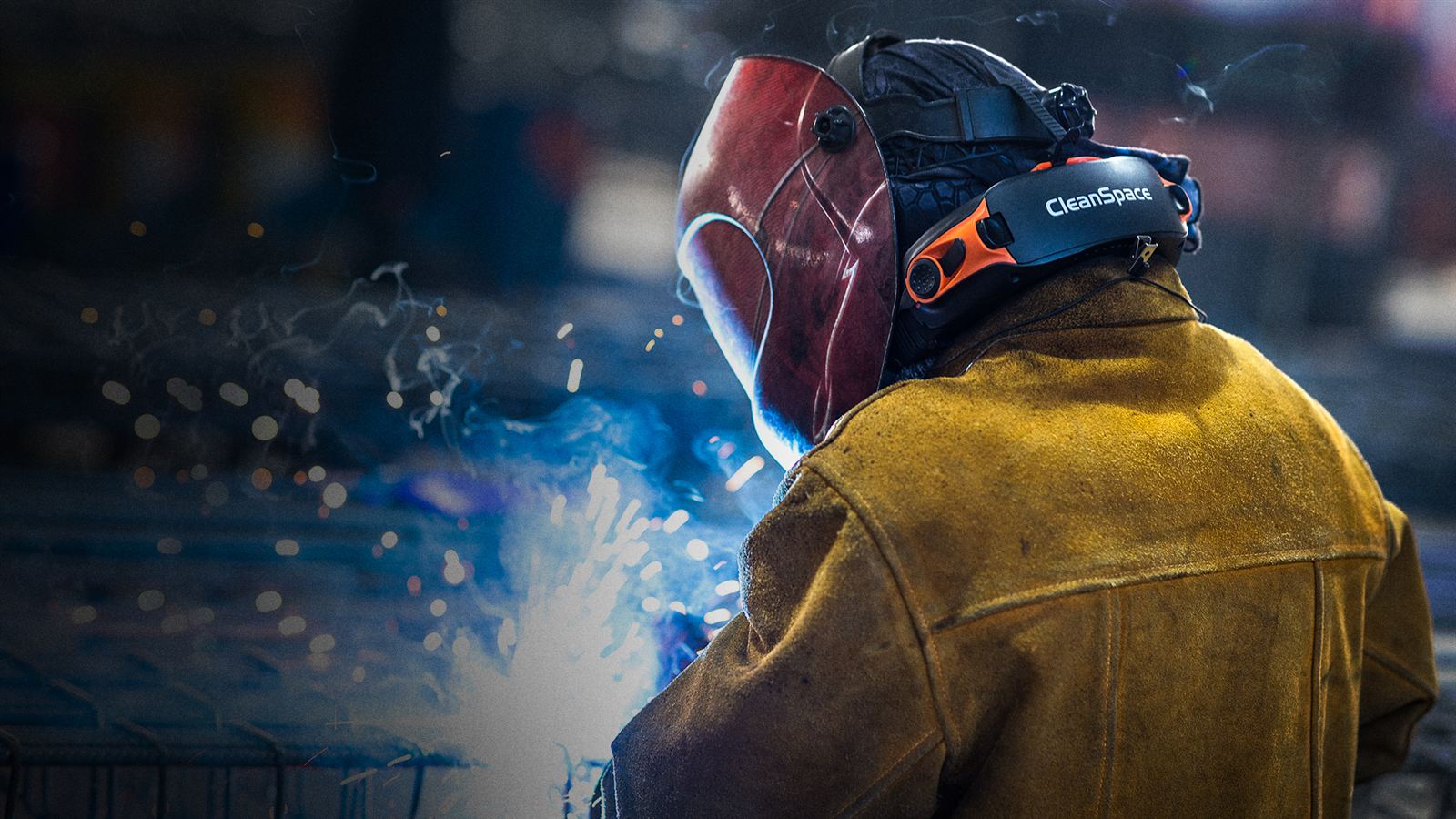
The CleanSpace powered respirator pushes filtered air into the mask under positive pressure. If the seal breaks for a moment, air flows out instead of in. AirSensit® technology follows the user's breathing and delivers air on demand. The whole unit sits on the head and neck, with no hose or belt, and works under the welding helmet.
| Respiratory protection | Type | Assigned protection factor (APF) | In practice |
|---|---|---|---|
| Disposable FFP2/N95 | Negative pressure: the lungs pull air through the filter | 10 | Depends on a perfect seal and fit testing; tiring over long shifts |
| CleanSpace with half mask | Powered, positive pressure | 50 | Less breathing effort; the airflow compensates for small seal leaks |
APF for a powered air-purifying respirator with half mask, according to the Fundacentro Respiratory Protection Program (Brazil) and OSHA 29 CFR 1910.134 (USA). Check the edition in force and the local regulation.
| Model | Recommended for | Weight | Filters | Key features | C.A. (Brazil) |
|---|---|---|---|---|---|
| CleanSpace WORK | Welding, part preparation, grinding and cutting, where particles and fumes are the main hazard | < 400 g | Particles and welding fumes | The lightest in the industrial range; compatible with hard hats and other PPE; easy to don and clean | to be confirmed |
| CleanSpace CST ULTRA | Maintenance, shutdowns, contractors and welding with solvents or anti-spatter | < 500 g | Particles, or combined particles + gases and vapors | SMART app and Insights reports; IP65 | to be confirmed |
| CleanSpace EX | Hazardous (potentially explosive) areas, offshore | < 500 g | Particles, or particles + chemicals | Intrinsically safe (ATEX); IP66 | to be confirmed |
Technical data from the CleanSpace 2026 corporate material. Filtration efficiency up to 99.97%. Compatibility with each welding helmet model should be validated in the pilot. The C.A. is a Brazilian requirement (NR-6) and only applies in Brazil.
Proof that the welder wore it
CleanSpace Insights reports show when, where and for how long each CST ULTRA was used, with estimated protection and filter change alerts. It is evidence for audits and occupational health records.
Less heat, less effort
Moving air inside the mask reduces the stuffy feeling, and the motor does the work the lungs used to do. Comfort is what keeps PPE on the face.
Shared unit
Each welder has their own face piece and filters. One powered unit serves a group of 2 welders, which lowers the investment.
Other agents
Protocol for the other workstation risks
| Agent | How to evaluate | How to control |
|---|---|---|
| Heat | WBGT per SEG throughout the shift (NR-15 Annex 3 and NHO 06 in Brazil). The limit depends on the metabolic rate of the task. | Exhaust and ventilation; work-rest schedule; hydration with isotonic drinks; individual monitoring with heat stress monitors. |
| Noise | Hearing conservation program. Dosimetry per NHO 01 and NR-15, with octave-band analysis. With earmuffs, two-channel dosimetry: one at the hearing zone and one under the earmuff. | Welding noise is usually continuous and strongest above 1,000 Hz. Choose the protector by its attenuation at those frequencies: subtract each band's attenuation, add twice the standard deviation and ensure the result is below the action level (80 dB(A) under NR-15; 82 dB(A) under NHO 01). Where solvents are used, clean hands and protectors, or prefer earmuffs. |
| Radiation | Process, welding current and distance of other people from the arc. | Welding filter with the right shade for the process; curtains and screens; skin covered against UV. |
| Ergonomics | Ergonomic analysis of the workstation (NR-17) with the welders' participation. | Jigs and positioners; less work above shoulder height; exoskeleton (EXY) where the posture cannot be eliminated; lighter PPE. |
Return on investment
What the company spends today on disposables, and what it will spend with CleanSpace
Starting values follow the 20-user model from the CleanSpace material: 2 disposable respirators per welder per day. The powered unit is an annual cost: 1 unit per year for every group of 2 welders. Choose the currency and fill in the company's prices to see the result.
Compliance and records
Adequate PPE with proven use supports hazard pay management and occupational health records. Review with the company's legal and occupational health teams.
Absence and productivity
Fewer respiratory complaints and fewer breaks to replace or adjust disposables. Measure it in the pilot, before and after.
Waste
Thousands fewer disposables per year in industrial waste, a figure that goes straight into the sustainability report.
Implementation
From assessment to approval in four steps
Technical assessment
Visit with the health and safety team, SEG map of the welding area, survey of existing collective controls and current disposable respirator consumption.
30-day pilot
3 to 5 welders from the highest-risk SEG use CleanSpace in their routine. Usage recorded by Insights, filter consumption and user feedback.
Results report
Protection, acceptance, comfort and ROI with the pilot's real figures, presented to safety, health and purchasing.
Approval and follow-up
Technical specification, purchase through the authorized regional distributor, user training and quarterly usage report.
| Tracked indicator | Why it matters |
|---|---|
| Respirator hours of use per welder | Shows real acceptance, not just PPE delivery |
| Filters changed on time | Ensures protection and controls consumable costs |
| Disposables consumed in the area | Proves the savings forecast in the ROI |
| Respiratory complaints and absences in the SEG | Connects the program to worker health |
| Collective controls completed | Keeps PPE as the last barrier, not the only one |
Want to run the pilot at your plant?
Safety engineers and technicians, buyers and distributors: get in touch to schedule the assessment.
Sources: CleanSpace Corporate Deck 2026 (product data and 20-user model); IARC Monograph 118 (welding fumes, 2017); Fundacentro, Respiratory Protection Program; OSHA 29 CFR 1910.134; Brazilian standards NR-6, NR-15 (Annex 3) and NR-17; Fundacentro NHO 01 and NHO 06; ACGIH.
C.A. of the CleanSpace models and prices: to be confirmed. This material guides implementation and does not replace the company's quantitative exposure assessments.